In a [previous post](https://blog.techdominator.com/article/circuit-breaker-pattern-part-1-basic-principle.html), we presented the *Circuit Breaker* design pattern and discussed it usefulness in building stable back-end services.
In this post, we are going to take a look at an example .NET Core implementation of the pattern that you can find in this [Github repository](https://github.com/MissaouiChedy/CircuitBreakerSample).
## High Level Structure and Behavior
In this example, we have a .NET Core console application that uses a MongoDB database instance, a very simple structure:
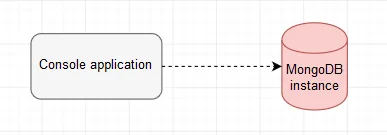
The console app asks the MongoDB instance to perform two operations:
- Writing a single `Person` document in the `persons` collection
- Reading all `Person` documents from the `persons` collection
`Person` is a very simple C# class, here is its definition:
When executed the console app will perform 100 sequential operations, in each iteration the program randomly selects one of the two previously described operations(`read` or `write`).
Executing the program with a running database instance produces output similar to the following:
```
Written: { Id: 3, Name: 'Baby Roy 3'}
Read => { Id: 3, Name: 'Baby Roy 3'}
Read => { Id: 3, Name: 'Baby Roy 3'}
Read => { Id: 3, Name: 'Baby Roy 3'}
Written: { Id: 7, Name: 'Baby Roy 7'}
Written: { Id: 8, Name: 'Baby Roy 8'}
Written: { Id: 9, Name: 'Baby Roy 9'}
Written: { Id: 10, Name: 'Baby Roy 10'}
```
By killing the database instance you will start seeing timeout errors as follows:
```
MongoDB.Driver.MongoCommandException: Command find failed: interrupted at shutdown.
MongoDB.Driver.MongoConnectionException: An exception occurred while
sending a message to the server.
System.TimeoutException: A timeout occured after 2000ms selecting a server
...
```
When `Config.CircuitClosedErrorLimit` is reached the circuit gets opened:
```
CircuitBreakerSample.Exceptions.CircuitOpenException:
Exception of type 'CircuitBreakerSample.Exceptions.CircuitOpenException' was thrown.
```
Finally, starting back the database instance will cause the circuit to close at some point:
```
CircuitBreakerSample.Exceptions.CircuitOpenException:
Exception of type 'CircuitBreakerSample.Exceptions.CircuitOpenException' was thrown.
Read => { Id: 8, Name: 'Baby Roy 8'}, ...
Written: { Id: 41, Name: 'Baby Roy 41'}
...
```
## Deeper Level Structure
The following class diagram depicts the internal structure of the console application:
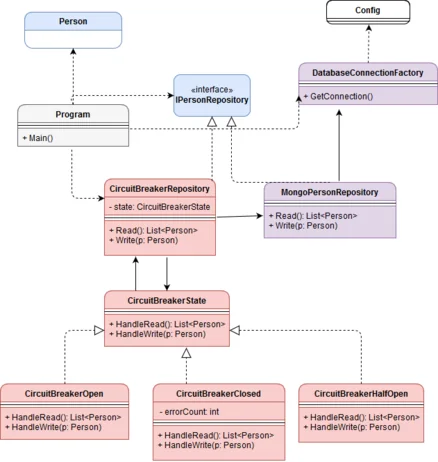
The [`Program`](https://github.com/MissaouiChedy/CircuitBreakerSample/blob/master/src/Program.cs)class contains the `Main` method which is the entry point of the application, this is where we implemented the previously described behavior.
The `DatabaseConnectionFactory` is responsible for creating and returning a `MongoClient` instance that is going to be used by the `MongoPersonRepository` to issue requests to the database instance.
The `MongoPersonRepository` implements the `IPersonRepository` interface and is the actual gateway to the external MongoDB instance, as you can see in the following this class is not used directly by `Program.Main`:
Instead we use the *circuit breaker* version `CircuitBreakerRepository` which implements the same `IPersonRepository` and which wraps the `MongoPersonRepository` to add circuit breaking features.
Now let's take a closer look at it.
### The Circuit Breaker repository
In the [basic principles post](https://blog.techdominator.com/article/circuit-breaker-pattern-part-1-basic-principle.html), we mentioned that the circuit breaker is a state machine that has 3 states with defined transitions:
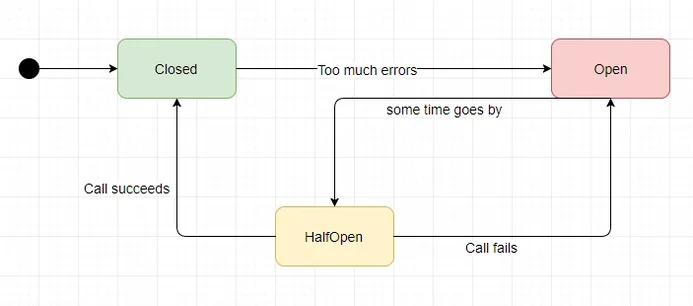
Essentially, state machine objects execute different behaviors depending on their state, this can be implemented by using nested `if` or `switch` statements, by using a [decision table](https://en.wikipedia.org/wiki/Decision_table) or by using *the state design pattern*.
In this example, the `CircuitBreakerRepository` defines a class hierarchy that is useful for handling state specific behavior and state transitions.
The `CircuitBreakerState` abstract class represents a state handler and have three concrete sub-classes:
- `CircuitBreakerClosed` which handles the closed state
- `CircuitBreakerOpen` which handles the open state
- `CircuitBreakerHalfOpen` which handles the half open state
The *state pattern* allows us to factor state machine code very neatly, to learn more about it you can checkout the following:
- The state design pattern chapter in [Design Patterns: Elements of Reusable Object-Oriented Software](https://www.amazon.com/Design-Patterns-Elements-Reusable-Object-Oriented/dp/0201633612)
- The state diagram chapter in [UML Distilled](https://martinfowler.com/books/uml.html)
- [This link](http://www.dofactory.com/net/state-design-pattern)
## Closing Thoughts
This example is a very basic and simple implementation, it is possible to implement more sophisticated behaviors such as:
- Saving documents in a caching layer in `CircuitBreakerOpen.Write` and making sure that they are written when transitioning to the closed state
- Opening the circuit when high latency is detected
- Basing the error limit on a robust statistical measure rather than simple error counting (error frequency for example)
These are left as an exercise to the reader